
Choosing the Right Path: Construction Delivery Methods for School Districts
For leaders in K-12 construction management, including school administrators, superintendents, and school board members, embarking on a major facility project is one of the most significant responsibilities they will face. Beyond the architectural vision and excitement of a new facility lies a complex landscape of financial risk, legal responsibility, and project oversight. One of the most important decisions a district makes, often before construction even begins, is selecting the right construction delivery method, including evaluating options such as design-build vs construction manager approaches.
The choice you make will dictate who holds the contracts, how costs are controlled, and how much risk the district assumes. In our recent webinar, Allied Facility Partners joined forces with education law experts to break down the most effective paths for Illinois school districts.
This guide outlines the primary construction delivery methods for schools and explains how each school construction project delivery approach can help your leadership team move forward with clarity and confidence.
1. Traditional Construction Management (CM as Advisor)
In the Construction Manager as Advisor (CMa) model, the school district stays in direct control of the project while the Construction Manager provides guidance on budgeting, scheduling, coordination, and overall project oversight.
How It Works
The district holds contracts directly with each trade contractor, such as plumbing, electrical, and mechanical firms. The Construction Manager helps coordinate the work and provides expertise throughout the project but does not assume construction risk.
Advantages
- Full transparency into project costs and bidding
- Competitive public bidding process
- Greater owner control and direct contractor relationships
Limitations
- Increased administrative responsibility for the district
- Greater owner risk for contractor coordination and delays
- Requires active involvement and oversight from the district
Ideal Use Case
Best suited for districts with experienced facilities teams that want maximum transparency, greater control, and are comfortable managing multiple contracts.
2. Construction Management at Risk (CMAR)
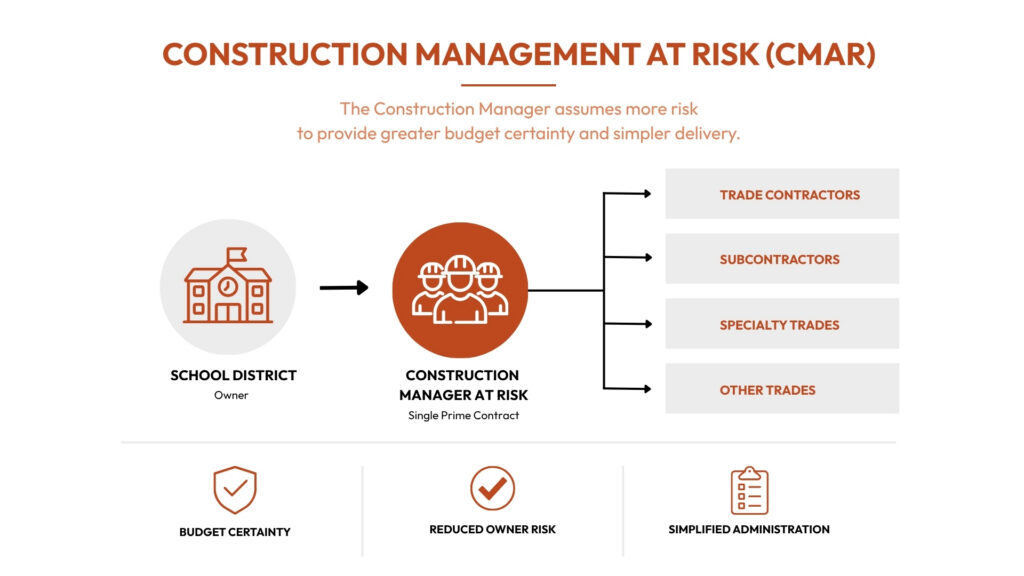
In the Construction Manager at Risk (CMAR) model, a portion of the project risk is transferred from the district to the Construction Manager, providing greater budget predictability and simplified project administration.
How It Works
During pre-construction, the CM works alongside the architect to develop cost estimates and project planning. Once the design is finalized, the CM provides a Guaranteed Maximum Price (GMP) and holds the contracts with all subcontractors.
Advantages
- Greater budget certainty through the Guaranteed Maximum Price
- Reduced owner risk for cost overruns and subcontractor coordination
- Simplified administration with one primary contract
Limitations
- Higher fees due to the CM assuming additional risk
- Less financial transparency into subcontractor pricing and agreements
Ideal Use Case
Best suited for districts that prioritize budget certainty, want to reduce administrative burden, and prefer to limit exposure to construction and coordination risks.
3. General Contractor (Design-Bid-Build)
The Design–Bid–Build method is the traditional “low-bid” delivery approach and is often the most familiar to school boards. It follows a linear process: design first, then bid, then construct.
How It Works
The district hires an architect to complete full construction documents. The project is then publicly bid, and the district typically awards the contract to the lowest responsible general contractor.
Advantages
- Familiar and widely understood by districts and boards
- Competitive bidding can reduce initial construction costs
Limitations
- Higher potential for change orders if design gaps are discovered during construction
- More fragmented responsibility between designer and contractor, which can lead to disputes or misalignment
Ideal Use Case
Best suited for smaller, straightforward projects with a clearly defined scope and minimal expected design changes.
4. Design-Build
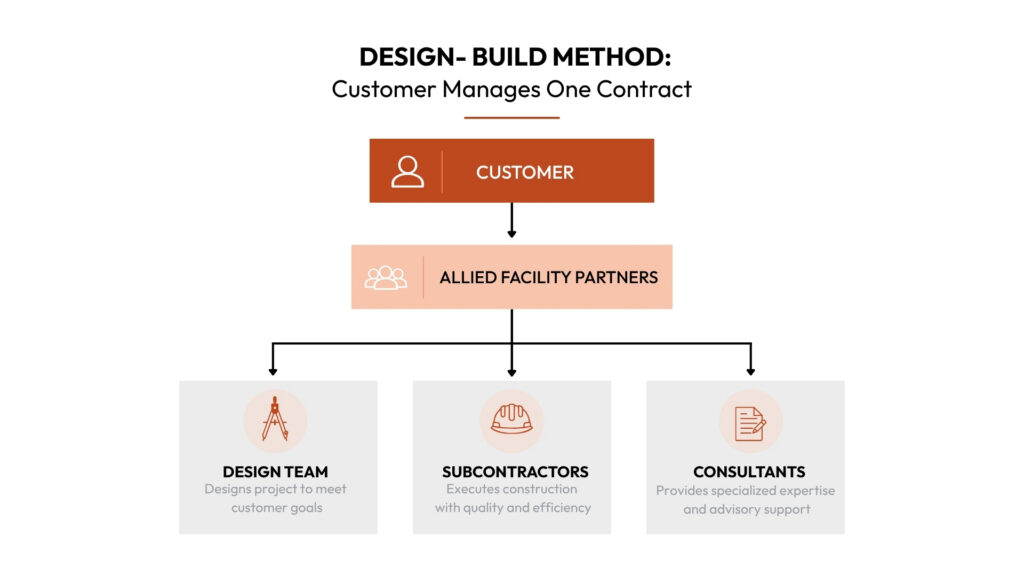
In the Design–Build delivery method, the district contracts with a single entity responsible for both design and construction, creating a streamlined “single point of accountability.”
How It Works
Instead of managing separate contracts for the architect and contractor, the district enters into one agreement with a Design–Build team that handles both services from concept through completion.
Advantages
- Faster project delivery through overlapping design and construction phases
- Single point of accountability for both design and construction performance
- Improved coordination and reduced communication gaps between designer and builder
Limitations
- Reduced district control over detailed design decisions after contract award
- Less independent oversight since the designer and contractor are part of the same team
Ideal Use Case
Best suited for projects where speed is a priority and districts are comfortable trading some design control for efficiency and streamlined delivery.
5. Guaranteed Energy Savings Contracts (GESCs)
Used in Illinois and many other states, Guaranteed Energy Savings Contracts (GESCs) allow school districts to fund facility improvements through the energy savings those upgrades generate.
How It Works
An Energy Services Company (ESCO) identifies and implements energy-efficient upgrades such as HVAC systems, lighting improvements, and building envelope enhancements. The project is repaid over time using the verified savings on utility costs.
Advantages
- No upfront capital required for major facility improvements
- Guaranteed savings, with performance guarantees typically provided by the ESCO
- Enables immediate modernization of aging infrastructure
Limitations
- Limited to improvements that directly produce energy savings
- Requires detailed legal and financial review to ensure compliance with state requirements and savings calculations
Ideal Use Case
Best suited for districts with aging mechanical or energy systems that lack available capital but need to modernize facilities and reduce long-term operating costs.
6. The Hybrid Approach: Innovative Delivery
Every school district is unique, and a one-size-fits-all model doesn’t always fit. A Hybrid Delivery method allows districts to blend approaches—for example, using a CMAR model for a new addition while utilizing a GESC for district-wide boiler replacements.
By tailoring delivery methods to each scope of work, districts can better balance cost, risk, and schedule across a portfolio of projects. This approach requires strong legal oversight and a partner who understands the nuances of the Illinois School Code.
How to Choose the Right Construction Delivery Method for Your School District
Selecting a construction delivery method in K-12 construction management is not just a technical decision; it is a responsibility to ensure public resources are used wisely. Whether prioritizing the transparency of a Construction Manager as Advisor (CMa) or the risk mitigation of CMAR, understanding these delivery paths helps ensure district resources are used effectively to create the best possible learning environments.
At Allied Facility Partners, we specialize in helping K–12 leaders navigate these complex decisions. We act as your advocate, ensuring each project is grounded in transparency, accountability, and long-term value.
Ready to determine the best path for your next project? Connect with Allied Facility Partners today to schedule a strategy session and evaluate which delivery method best aligns with your district’s goals.